What behavioral health teams are trying to solve with AI
Behavioral health programs are usually trying to solve two operational problems at once: keep patients engaged between visits, and produce audit-ready compliance and reporting support without adding staff burden. In practice, that means using behavioral health AI to automate reminders, follow-ups, and escalation when a patient misses a visit or stops responding, while also capturing the documentation needed for quality review, measurement-based care, and payer or regulatory reporting.
Those jobs matter more in behavioral health because the cost of a missed touchpoint is high. No-shows can interrupt continuity, delay intervention, and increase relapse risk. At the same time, teams are already carrying a heavy documentation load across intake, care coordination, and ongoing monitoring. The wrong AI layer adds noise. The right one reduces manual chasing and makes the record easier to defend.
That is the frame for this article. First, we compare technologies for automated reminders and follow-ups. Next, we look at compliance and reporting capabilities, including audit trails, HIPAA safeguards, and documentation support. Then we cover implementation fit: escalation rules, alert fatigue, and how AI should govern clinical reasoning across existing EMRs, scribes, and billing systems while leaving those systems in place.
For a useful reference point on the engagement side, see cliexa’s connected patient experience workflow.
What AI technologies automate reminders and follow-ups for behavioral health patients?
Behavioral health programs usually need more than a single reminder text. They need a workflow that can nudge attendance, confirm intent, recover missed visits, and keep patients engaged between appointments without adding avoidable staff work. In practice, that means using different AI channels for different jobs.
Conversational AI is the most flexible option. It can send a reminder, accept a reply, ask a confirmation question, and route the patient based on what comes back. For example, if a patient replies that they cannot attend, the system can offer a rescheduling prompt. If the reply suggests risk, symptom worsening, or a crisis concern, it can escalate to staff for human follow-up. That two-way exchange is the main advantage of conversational AI in behavioral health AI workflows: it handles routine back-and-forth while preserving a path to clinical review when needed. cliexa’s connected patient experience model describes this kind of always-on engagement through chat, SMS, app, or portal channels, with personalized triage and between-visit support (connected patient experience).
SMS workflows are the fastest and lowest-friction channel for appointment nudges. They work well for confirmation requests, “reply 1 to confirm” prompts, and missed-visit recovery sequences. SMS is efficient, and it is also limited: it works well for short actions and less well for deep conversation.
Voice workflows help when patients do not respond to text or prefer a call. Automated voice can deliver reminders, collect confirmations, and leave callback instructions. It is useful for older populations or patients with limited texting access, and it usually creates more operational overhead than SMS.
Portal and app messaging support richer follow-up. These channels can carry appointment reminders, education, care-plan prompts, and secure messages tied to the chart. They are slower than SMS in response rate, and they can be more detailed and easier to document.
For missed-visit recovery, the best systems use a sequence: reminder, confirmation request, no-show alert, rescheduling prompt, and staff escalation if the patient remains unreachable. For between-visit engagement, remote patient monitoring and symptom check-ins fit naturally into the same workflow. cliexa’s patient experience platform explicitly supports personalized remote patient monitoring, symptom tracking, adverse-effect reporting, and alerts that can surface inside the EMR when trends change (connected patient experience).
The practical tradeoff is simple: SMS and voice reduce staff workload, conversational AI adds personalization and two-way handling, and portal and app messaging improve documentation and depth. The right mix depends on how quickly you need a response, how much context the patient needs, and how tightly the workflow must connect to existing systems and compliance rules.
How behavioral health AI supports compliance and reporting
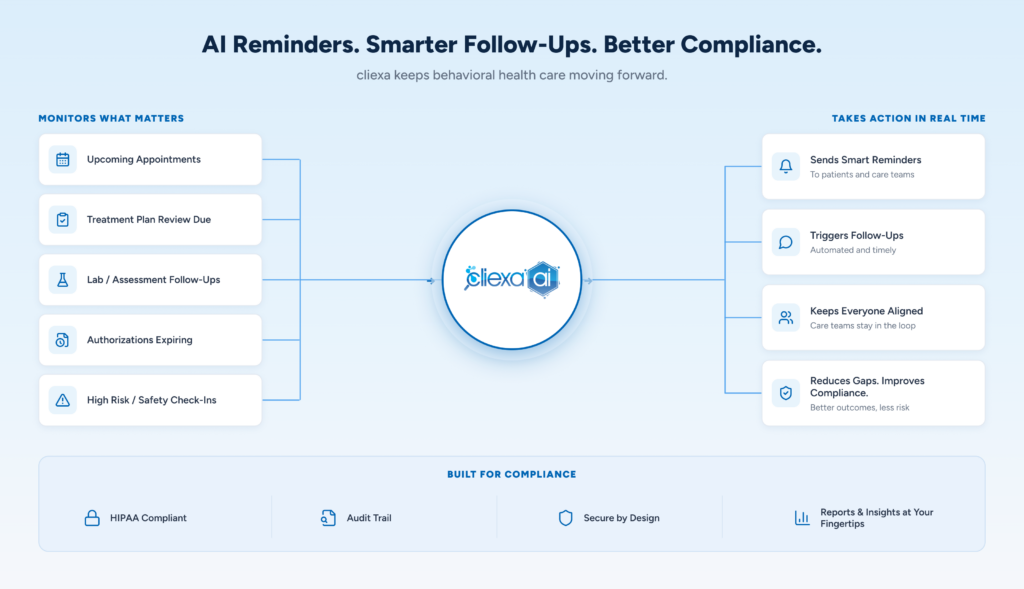
Behavioral health AI supports compliance and reporting when it does more than send reminders. In practice, it should help teams document what happened, when it happened, who reviewed it, and what action followed. That is the difference between automation that saves time and automation that can stand up to audit, quality review, and billing scrutiny.
A key concept is the audit trail: a time-stamped record of activity that shows the sequence of outreach, responses, escalations, chart updates, and follow-up tasks. In behavioral health, audit trails matter because care often spans multiple touchpoints such as intake, missed visits, care coordination, medication follow-up, and crisis escalation. If a program cannot reconstruct those steps, it is harder to prove that outreach occurred, that a risk signal was acted on, or that documentation supports the clinical decision made. cliexa logs every AI inference, including the input data, the rules applied, and the output generated, and retains those logs for audit, monitoring, and incident investigation.
HIPAA safeguards are equally important. For behavioral health AI, that means controlling who can see patient data, limiting message content to the minimum necessary, protecting data in transit and at rest, and making sure outreach channels are handled in a compliant way. It also means clear access controls for staff and role-based permissions for review, editing, and escalation. Generic “AI compliance” claims are not enough here; behavioral health programs need safeguards that fit real workflows, including SMS, portal messages, and internal handoffs. cliexa runs on HITRUST r2 certified infrastructure with HIPAA and HITECH compliance, Business Associate Agreements in place, encryption in transit and at rest, role-based access, and full audit logging of every AI inference. When you evaluate any tool, verify how it handles message routing, consent, and data retention against that kind of baseline.
Measurement-based care reporting is the other half of the equation. This is the practice of tracking outcomes over time using structured measures, alongside narrative notes. Behavioral health AI can help capture follow-up activity, missed-visit recovery, symptom trends, and care gaps so teams can see whether patients are improving or drifting out of care. That supports population health reporting, quality review, and risk stratification.
The strongest use cases connect compliance to daily operations: complete documentation, cleaner billing support, and faster chart review. This is where cliexa’s ChartKeeper quality audit capability fits. Powered by cliexaAI, ChartKeeper scores each note for clinical integrity, completeness, and timeliness, surfaces the specific missing elements, and returns a concrete coaching target to the provider and supervisor. Because that oversight runs on cliexa’s HITRUST r2 certified, HIPAA-compliant platform, it is built for behavioral health PHI from the ground up. For enterprise programs, the goal is to govern clinical reasoning across existing systems so reporting stays accurate, defensible, and usable, while the EMR remains the system of record.
Implementation considerations for behavioral health teams
Adopting behavioral health AI works best when it is mapped to the actual care pathway, rather than bolted onto a generic automation stack. The practical question goes beyond “Can it send reminders?” to “Where does it reduce missed work without changing clinical judgment?”
Start with four workflow points:
-
Intake: use AI to confirm demographics, collect screening data, and route high-risk responses for review before the visit.
-
Missed-visit recovery: trigger outreach after a no-show, and keep the message sequence short and documented so staff can intervene when needed.
-
Care coordination: surface unresolved tasks across therapists, prescribers, case managers, and peer support so handoffs do not depend on memory.
-
Post-visit follow-up: send check-ins after medication changes, discharge, or crisis visits, then escalate if the patient does not respond.
Escalation rules should be explicit and written before launch. A safe default is: if a patient reports suicidal ideation, relapse risk, or worsening symptoms, the system should stop routine automation and route the case to a clinician or designated crisis workflow. If there is no response after a defined number of outreach attempts, the case should move from automated follow-up to human review. The threshold should be based on program policy, not vendor defaults.
To reduce alert fatigue, limit notifications to clinically meaningful events. Not every missed message needs an alert. Reserve real-time alerts for high-risk responses, repeated non-response, or changes that affect disposition. Lower-severity events can be batched into a task queue for care managers or administrators.
Role alignment matters. Care managers should own outreach queues and documentation. Peer support staff can handle engagement and recovery calls when risk is low. Clinicians should receive escalations tied to safety, diagnosis, or treatment changes. Program administrators should monitor completion rates, response times, and compliance reporting.
Integration is also non-negotiable. The platform should work with existing EMRs, scribes, and billing systems so notes, tasks, and codes stay in the current record. That is the operating model cliexa uses: AI governs the reasoning layer and patient engagement between visits, while the core systems of record remain intact. The implementation test is simple: does the system fit the workflow, document the decision, and escalate safely? cliexa is built to pass that test, governing the reasoning and engagement layers while your EMR, scribe, and billing systems stay in place.
Which behavioral health AI approach fits which use case?
The right behavioral health AI approach depends on the job to be done. In practice, there are two related but distinct capabilities: reminder and follow-up automation, and compliance and reporting support. Programs often need both, and they solve different operational problems.
For appointment reminders, the best channels are usually SMS, app notifications, patient portal messages, and voice calls for higher-touch populations. The goal is simple: reduce no-shows and confirm attendance. For missed-visit recovery, the system should do more than resend a reminder. It should trigger a structured outreach sequence, route the patient to rescheduling, and escalate to staff when risk is elevated or contact attempts fail. For ongoing check-ins, chat, SMS, and portal-based symptom prompts work well because they can run between visits without adding front-desk burden. cliexa’s connected care model is built around this kind of always-on engagement, including chat, SMS, app, and portal workflows that can run behind the scenes or surface alerts when needed (connected patient experience).
Compliance and reporting tools are a different category. Here, the most important features are audit trails, role-based access, HIPAA safeguards, and documentation that supports measurement-based care. Behavioral health programs also need clear traceability: what was captured, when it was reviewed, and when a human intervened. That matters for audit readiness and for proving that care processes are consistent, alongside being automated.
The tradeoff is straightforward: deeper automation reduces manual work, and it can also increase the need for escalation rules and exception handling. Generic rulesets create alert fatigue; context-aware workflows perform better (decision support that fits the room). The best fit depends on program type, risk level, and workflow maturity. High-risk populations usually need tighter human review. More mature programs can automate more, as long as the system fits existing EMR, billing, and care coordination workflows.
The bottom line
Behavioral health teams are solving two problems at once: keeping patients engaged between visits and producing documentation that can stand up to audit. The tools that help most treat those as one connected job rather than two disconnected point solutions. cliexa governs that connection. cliexaAI runs the reasoning layer across engagement and documentation, ChartKeeper scores every note and surfaces the gaps, and the whole thing runs on HITRUST r2 certified, HIPAA-compliant infrastructure with every AI inference logged. Your EMR, scribe, and billing systems stay in place as the systems of record. The result is fewer missed touchpoints, cleaner and more defensible charts, and measurement-based care reporting you can actually trust, without adding staff burden.
See how cliexa turns follow-ups into audit-ready records.
Reminders and chart audits only help if your team trusts them and acts on them. In a 30-minute walkthrough, we’ll show how cliexa automates engagement between visits, scores every note for the gaps that drive denials, and escalates the right cases to a clinician, all inside the systems you already use. No black box, no extra dashboard to check.
Frequently Asked Questions
What AI technologies can automate reminders and follow-ups for behavioral health patients?
The most useful behavioral health AI tools are the ones that can reach patients where they already respond: SMS, app messages, patient portals, chat, and automated phone workflows. In practice, that includes appointment reminders, missed-visit follow-up, intake prompts, symptom check-ins, and care-plan nudges between visits. Some systems also support dynamic screeners and triage before the visit, then continue engagement after the visit with symptom tracking or adverse-effect reporting. cliexa’s connected care model, for example, describes AI that can automate engagement and work through chat, SMS, app, or portal while integrating with existing workflows (connected patient experience).
How do behavioral health AI tools support compliance and reporting?
They help in three separate ways, and buyers should evaluate each one independently:
-
HIPAA-safe outreach: controls for secure patient communication, access, and data handling.
-
Audit trails: logs that show what was sent, when it was sent, and what action followed.
-
Measurement-based care reporting: structured capture of symptoms, screening results, and follow-up outcomes for quality and program reporting.
These are separate features. A tool can send reminders and still lack usable audit logs. It can collect patient-reported data and still miss reporting support. It can be HIPAA-aware in outreach and still offer no help with measurement-based care. cliexa covers all three: HIPAA-compliant, HITRUST r2 certified outreach; full audit logging of every AI inference; and structured capture that feeds measurement-based care reporting.
For population and behavioral health programs, the right test is simple: does the system reduce missed follow-ups, document the workflow clearly, and surface the right data without adding alert fatigue? cliexa’s approach to decision support emphasizes context, workflow fit, and putting the right data in the right place (decision support that fits the room).