Why clinician admin burden is still the bottleneck in AI healthcare platforms
Clinician administrative burden is the work that surrounds care: documentation, inbox management, prior authorization, handoffs, and follow-up coordination. In chronic disease programs, that work scales fast, and it is often where delays, missed tasks, and burnout start.
That is why broad AI claims are not enough. An AI healthcare platform has to map to real workflow steps: intake, note creation, payer work, and care-team routing. If it cannot show where data enters, who reviews it, and how actions are documented, it will not reduce burden in practice.
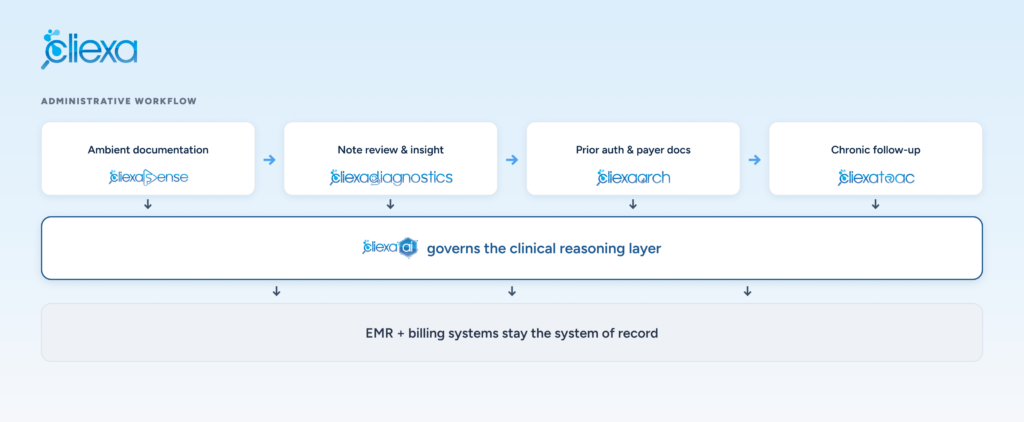
The right model is integration. The platform should sit inside existing EMRs, scribes, and billing systems, governing the clinical reasoning layer so teams keep their stack instead of rebuilding it. That is the model cliexa uses: AI governs the reasoning that flows through your systems, and the EMR stays the system of record.
Before implementation, teams should confirm:
- Access to EMR and billing workflows
- Current documentation templates
- Prior authorization data sources
- Care-team roles and routing rules
- Time for workflow mapping and review
This guide will then walk through the prerequisites, the step-by-step workflow, the governance checks that protect data and documentation quality, the measurable outcomes to track, the adoption issues that usually slow rollout, and the FAQ clinical leaders ask most often.
For leaders asking how AI healthcare platforms improve chronic disease management programs, the answer starts here: reduce administrative drag first, then measure whether the platform improves throughput, consistency, and follow-up reliability.
Prerequisites: workflows, data inputs, and governance needed before AI can help
Before an AI healthcare platform can reduce administrative burden, the organization has to define the work it will support. Start by mapping the core workflows: intake, documentation, prior authorization, follow-up, and handoff. The expected outcome is a clear view of where AI can assist without creating duplicate steps or hidden work.
Next, specify the data inputs the platform must read and write. That usually includes structured EMR data, encounter notes, claims context, payer rules, device data, and care-plan status. The expected outcome is a complete clinical picture drawn from more than one visit. This matters most in chronic disease management, where decisions depend on longitudinal trends and care-team coordination rather than isolated notes.
Then, confirm integration points before deployment. The platform should connect to the EMR, touch billing systems where needed, fit into the scribe workflow, and enforce role-based permissions. The expected outcome is that clinicians and staff see AI support inside existing systems, so they never open a separate tool that adds clicks.
Finally, establish governance controls up front. Require HIPAA safeguards, audit logs, encryption, human review, validation, and documentation of AI outputs. The expected outcome is traceable clinical reasoning that can be reviewed, corrected, and defended. For leaders evaluating compliance and security features, these controls align with the four principles cliexa summarizes in its CMS AI guidance for healthcare leaders, and with the administrative-complexity problem described in cliexa’s health systems overview.
If those prerequisites are missing, AI may still generate text. It will not reliably support care.
Step 1: Map the burden across the workflow, step by step
Start by breaking administrative work into sequence-based tasks that follow the workflow, rather than sorting by job title. In a typical visit, the burden shows up in intake, chart prep, note drafting, coding support, prior authorization, and post-visit follow-up. That sequence matters because an AI healthcare platform should reduce friction at the handoff points where work is duplicated, delayed, or re-entered.
Map each step to two questions: where do clinicians lose time, and where do staff absorb manual rework? For example, a physician may spend extra minutes reconstructing history because intake data was incomplete, while a care coordinator later fixes missing fields for billing or prior auth. Those are different failure points inside the same workflow. This is where administrative complexity becomes expensive at scale. Industry estimates put administrative complexity at roughly $265B a year in U.S. health systems, one of the figures cliexa cites alongside fragmented data, denial-prone claims, and siloed workflows in its health systems overview.
Include payer integration and interoperability in the map. If documentation cannot move cleanly into the EMR, billing platform, or payer workflow, the burden simply shifts downstream. Clinician preference alone is not enough; leaders need to see where data breaks, where documentation is incomplete, and where approvals stall.
This is especially important in chronic disease programs. Repeated visits, remote monitoring, and longitudinal care create recurring admin load across every touchpoint. A good workflow map shows where an AI healthcare platform can standardize documentation, surface missing data earlier, and reduce repetitive follow-up while leaving the systems already in place intact.
Step 2: Use AI to draft documentation and ambient scribing support
- Capture the encounter in real time and convert it into a draft note. An ambient scribe listens to the visit context, then organizes the conversation into a structured note draft. In practice, that means the AI healthcare platform can pull out the chief complaint, history, assessment cues, and next steps while the clinician stays present with the patient. cliexa’s AI Scribe is built for this, learning clinical and payer rules so the first-pass note is cleaner and more compliant from the start.
- Summarize the visit into documentation-ready sections. Use AI to turn raw encounter data into problem-oriented documentation: visit summary, problem list, medication changes, orders, and follow-up instructions. This reduces after-hours charting because the clinician reviews a draft instead of rebuilding the note from memory after clinic. It also helps chronic disease management programs by keeping longitudinal details organized across repeated visits, which improves continuity and makes trends easier to see. cliexa’s Clinician Insights surfaces this documentation and insight from real-time clinical data.
- Route the draft through clinician validation before sign-off. The clinician remains responsible for final review, edits, and attestation. That control point matters: AI can draft, and it should never finalize clinical documentation on its own. This preserves documentation quality, supports defensible records, and aligns with the responsible-AI expectations of keeping a qualified human in the loop and documenting the reasoning behind the final record. See cliexa’s guidance on responsible clinical AI.
- Reduce handoffs between the clinician, scribe, and billing team. When documentation is generated inside the workflow, fewer details get lost in manual transfers. The note can be reviewed once, then used downstream for coding, prior authorization support, and reimbursement documentation. That lowers rework across departments and eases the administrative complexity health systems face at scale. cliexa’s health systems overview describes this as a single intelligence layer that aligns care delivery, workflow, and reimbursement.
- Use real-world workflow data to measure burden reduction. Track time spent charting after hours, note completion lag, and correction rates before and after deployment. Evidence from clinical AI adoption shows that documentation support delivers the most value when it is embedded directly in real workflows. The goal reaches past faster note writing to fewer administrative touchpoints, less burnout, and more time for patient care.
Step 3: Automate prior authorization and payer-facing documentation
- Capture the encounter once and reuse it across documentation, coding, and prior auth. An AI healthcare platform should pull the visit note, diagnosis, treatment plan, and relevant history from the encounter context, then assemble payer-ready documentation from that same source of truth. The goal is simple: clinicians document once, and the system formats the evidence for the billing team, prior authorization packet, or EMR workflow already in use.
- Check for missing payer fields before submission. Before a request leaves the workflow, the platform should flag gaps such as incomplete diagnosis support, missing treatment duration, or absent clinical rationale. That reduces rework, shortens back-and-forth with payers, and lowers the chance that staff must chase down chart details after the fact.
- Align documentation to payer rules and medical necessity language. Prior authorization moves faster when the documentation matches what payers expect to see: diagnosis, severity, prior therapies, response to treatment, and why the requested service is clinically appropriate. In practice, this means fewer manual follow-ups and less time spent translating a clinical note into payer-facing language. cliexa’s Billing Insights works as a preemptive, self-learning billing engine aligned with payer rules, so this alignment happens before submission.
- Route the completed packet through existing billing and EMR systems. The platform should keep documentation, review, submission, and status tracking connected to the chart and revenue cycle process, so it operates inside the systems staff already use. That preserves auditability and avoids duplicate data entry.
- Use denial risk reduction as an operational target. Claims denials are common and expensive for health systems, and administrative complexity adds measurable cost across the enterprise. cliexa’s health systems overview frames this clearly: reduce fragmentation, keep data connected, and support reimbursement with AI-powered insights inside the EMR. When payer-facing documentation is complete the first time, teams spend less effort on appeals and more time on care.
For chronic disease programs, this matters because recurring visits generate recurring documentation. Better documentation support means faster prior auth turnaround, fewer denials, and less administrative drag on the care team.
Step 4: Keep chronic disease management aligned between visits
Use the AI healthcare platform to track the patient’s longitudinal story across every encounter. In chronic disease programs, much of the work happens between visits: reviewing trends, spotting risk changes, and making sure follow-up does not slip. When the platform pulls data from the EMR, care plans, labs, device feeds, and patient-reported updates, it can surface who is overdue for outreach, whose readings are drifting, and where the care plan is missing a next step. cliexa’s Connected Patient Experience supports this always-on engagement and monitoring between visits.
That matters because chronic care breaks down when information is fragmented. A patient with diabetes, heart failure, or COPD may have data in multiple systems, while the care team still needs one current view of status, goals, and pending actions. An AI layer can organize that context so nurses, physicians, care managers, and coordinators work from the same record of what changed, what was done, and what still needs attention. cliexa’s Universal Hub centralizes that clinical and financial view. The result is less time reconciling charts and more time executing the program.
Keep the platform additive to existing processes. It should augment care management by flagging exceptions, drafting outreach prompts, and preparing summaries for review inside the tools teams already use. That preserves clinical oversight and keeps staff out of a separate system.
This is where administrative burden reduction becomes operational value. Less manual chart review, fewer missed follow-ups, and cleaner handoffs translate into more consistent chronic disease management, well beyond faster documentation. For health systems building scalable programs, that consistency is often the difference between reactive care and coordinated care.
What measurable outcomes to track after implementation
Define a baseline before you launch. Measure current-state workflow first, then compare the same metrics after the AI healthcare platform is live. The goal is to confirm the system actually reduces administrative burden and does not simply add another layer of software. Start with a 30- to 90-day baseline for visit documentation, prior authorization, and care coordination.
Track time saved at the point of care. Measure time saved per visit, note completion speed, and after-hours charting. If clinicians finish notes sooner and spend less time closing charts at night, the platform is reducing cognitive load and documentation drag. For enterprise teams, even small per-visit gains compound across high-volume specialties. Health system leaders should also look for fewer interruptions during the encounter, since smoother documentation usually means fewer context switches.
Measure handoff reduction across teams. Count the number of manual handoffs between clinician, scribe, billing, and care management teams. A lower handoff rate usually means the workflow is more complete at the source and less dependent on follow-up messages, duplicate entry, or verbal clarification. This is especially telling when the platform sits alongside the EMR and governs the clinical reasoning layer while the EMR remains the system of record.
Monitor revenue-cycle and documentation quality. Track prior auth turnaround time, denial rates, and rework caused by missing documentation. These metrics show whether the platform is improving the quality and completeness of the chart before claims or authorizations move downstream. Enterprise AI creates measurable savings when it is deployed in the right sequence: capture, document, route, then bill.
Include chronic care program outcomes. For chronic disease workflows, monitor follow-up completion, care-plan adherence, and missed outreach rates. These measures show whether the platform is helping teams keep patients engaged between visits, well beyond documenting the visit itself. In chronic care, operational efficiency and patient adherence should move together.
Troubleshooting: adoption barriers, workflow fit, and compliance concerns
Step 1: Identify the adoption barrier before you blame the model. When clinicians are skeptical, the cause usually traces to workflow friction: extra clicks, unclear ownership, and outputs that do not match how care is actually delivered. A useful AI healthcare platform should reduce documentation and coordination work while sparing staff a second system to maintain.
Step 2: Fit the platform into the tools already in use. Avoid parallel workflows by integrating with the EMR, scribes, and billing systems your teams already trust. The goal is to govern the clinical reasoning layer inside existing operations, so clinicians never copy data between screens. When the platform sits outside the workflow, follow-up gets fragmented and chronic disease management programs lose continuity.
Step 3: Assign one owner for each action and decision. Role clarity matters. Define who reviews AI output, who signs off, and who is responsible for downstream tasks. In chronic care, stable data flows and explicit handoffs are what keep outreach, medication review, and escalation from falling through the cracks.
Step 4: Treat compliance as a design requirement. Healthcare leaders should ask for HIPAA alignment, SOC 2 controls, HITRUST certification where applicable, and security practices mapped to NIST and OWASP principles. Require encryption, audit logs, and human supervision for any clinical use case. For governance, the platform should support validation, transparency, and auditable documentation of outputs and decisions. That is the practical standard for responsible AI in clinical operations, and it aligns with the reasoning and documentation expectations described in cliexa’s AI guidance for healthcare leaders. cliexa itself is HITRUST r2 certified and HIPAA compliant, with every AI inference logged and auditable.
Step 5: Validate before scaling. Start with a narrow use case, measure error rates and turnaround time, then expand once the workflow is stable. This reduces implementation risk and gives compliance, clinical, and operations teams evidence they can defend.
The bottom line
Clinician administrative burden is the work that piles up around care, and it is where chronic disease programs lose time, money, and staff to burnout. An AI healthcare platform helps when it maps to real workflow steps and reduces friction at the handoffs, capturing the encounter once, drafting documentation for clinician review, aligning payer-facing evidence before submission, and keeping the care team on one current view between visits. cliexa is built for that layer: cliexaAI governs the clinical reasoning across AI Scribe, Clinician Insights, Billing Insights, and Connected Patient Experience, running on HITRUST r2 certified, HIPAA-compliant infrastructure with every inference logged. Your EMR, scribe, and billing systems stay in place as the systems of record. Reduce the administrative drag first, then measure throughput, documentation quality, and follow-up reliability to prove it worked.
See how cliexa cuts clinician admin work without replacing your stack.
Documentation, prior auth, and follow-up only get easier when AI lives inside the workflow your team already uses. In a 30-minute walkthrough, we will show how cliexa captures the encounter once, drafts payer-aligned documentation for clinician review, and keeps chronic disease patients on track between visits, all inside your EMR. No parallel system, no rip-and-replace.
Frequently Asked Questions
How does an AI healthcare platform reduce documentation burden without removing clinician oversight?
It should draft, structure, and route documentation while keeping the clinician as the final reviewer. The practical test is simple: the system can suggest note text, capture evidence, and surface missing fields, and a qualified person approves the record before it is signed. That matches the governance model CMS describes for responsible AI: human supervision, documented reasoning, and auditable outputs in controlled environments (CMS AI guidance summary).
How does it help with prior authorization and payer-facing documentation?
It reduces rework by assembling the clinical facts payers ask for: diagnosis, severity, prior treatments, labs, imaging, and timeline. In a health system setting, payer-aligned documentation is part of the workflow instead of a separate task, which helps reduce denials and back-and-forth between clinical and revenue cycle teams (health systems overview).
What benefits should chronic disease management programs expect?
Expect fewer manual handoffs, tighter follow-up, and better coordination across visits. When patient data, EMR context, and claims signals are unified, care teams can identify risk earlier, close gaps faster, and reduce the administrative drag that slows outreach and escalation. The benefit is operational: less time spent chasing information, more time spent acting on it.
What governance and security controls should buyers ask about before deployment?
Ask for HIPAA alignment, role-based access, encryption in transit and at rest, audit logs, version control, and clear data retention rules. Also ask how the vendor limits PHI exposure, how model outputs are reviewed, and whether the system can show its reasoning. For clinical AI, buyers should also ask how the platform aligns with NIST-style risk management and whether any FDA-related guidance is relevant to the use case.