

The question most executives are actually asking is narrower than the marketing category: which behavioral health AI platforms connect to the EHR you already run, and what does that connection do once it is live? Answering it well means separating three products sold under one label. The first is an AI-assisted EHR meant to replace your system of record. The second is an ambient scribe that produces notes. The third is a reasoning layer that runs alongside your existing systems and stays accountable to them.
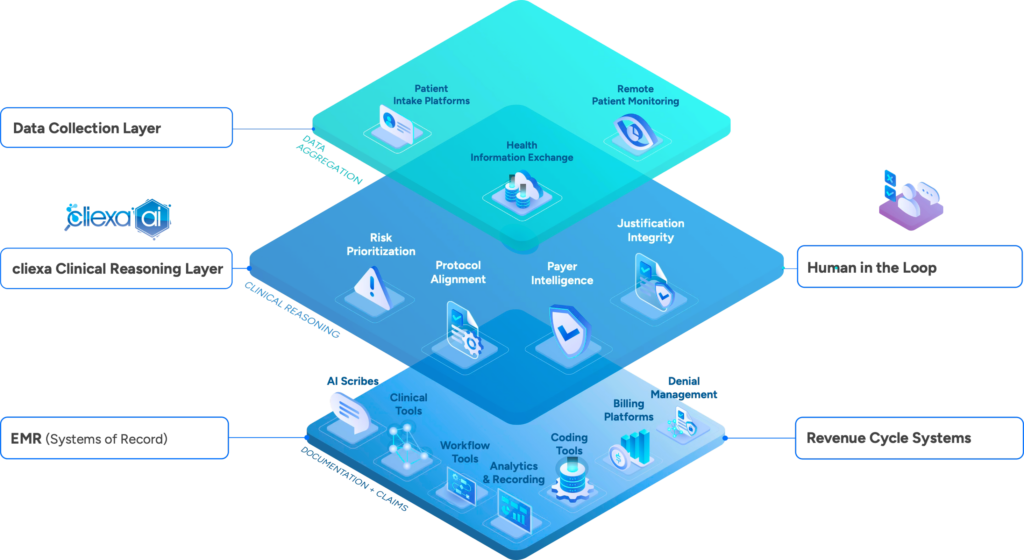
That distinction has system-level consequences. Clinical reasoning, documentation, coding, claims, and operational oversight in behavioral health are one continuous chain. When an AI tool owns only one link, the rest of the chain absorbs the rework. This is the shift cliexa frames as From Records to Reason: a reasoning layer that governs how information is interpreted across existing EMRs, scribes, and billing platforms, without becoming a new destination for data. cliexa does not replace your systems, your workflows, or your people. It governs the clinical reasoning that flows through them.
What are the three types of behavioral health AI platforms?
Behavioral health AI platforms fall into three architectures, and they are not substitutes: an AI-native EHR, an ambient scribe, and a reasoning layer. Each solves a different problem, and evaluating them on the same scorecard is how procurement cycles stall.
An AI-native EHR bundles intelligence into a new system of record. Documentation, scheduling, intake, and billing live in one environment. “Integration” here effectively means migration, because the new platform becomes the chart.
An ambient scribe listens to the encounter and drafts a note. It accelerates documentation, but its intelligence is bounded by the visit. A scribe captures what was said. It does not evaluate what the encounter means for coding, medical necessity, or level of care.
A reasoning layer runs alongside the EHR, the scribe, and the billing platform an organization already owns. It reads structured data, reasons over it against clinical guidelines and payer rules, and writes structured output back into the systems that remain the source of truth. The chart stays where it is. This is the layer cliexa is built to govern.
Which behavioral health AI platforms integrate with EHR systems?
Most behavioral health AI tools follow one of two integration models: coexistence, where the tool connects to the EHR you already run, or replacement, where the tool is the new EHR. Both are legitimate purchases. Naming which one a vendor sells is the first step in any evaluation.
Vendors that publish behavioral-health-specific EHR platforms, such as ICANotes and mdhub, sit closer to the replacement model. These platforms use natural language processing and AI-assisted documentation to automate clinical workflows across psychiatry, therapy, social work, and addiction treatment, and some market a broad footprint in one environment (charting, scheduling, intake, authorization, claims, patient portal, and telehealth) with a short implementation window. If your organization is replacing an aging behavioral health record anyway, a unified environment like that is genuinely the stronger fit: one contract, one vendor to hold accountable, and no interface engine work. Confirm implementation specifics with those vendors directly, since scope varies by module and by your existing stack.
cliexa is built for the other case. It operates as a clinical reasoning layer alongside the EHR, ambient scribes, and billing platforms an organization already owns, without becoming the record. The reasoning is powered by two modules: cliexaProtocols, a deterministic clinical rules engine, and cliexaAI, which applies guideline-based generative reasoning while maintaining awareness of comorbidities and longitudinal history. Together they produce output that is explainable and auditable while accounting for payer expectations.
The practical consequence is narrow and checkable. Epic, Cerner, or a behavioral-health-specific EHR stays the source of truth, and the cliexa reasoning layer governs how information is interpreted, escalated, and documented across those tools through cliexaConnect, cliexa’s interoperability module. The tradeoff is equally plain: a reasoning layer will not give you scheduling, a patient portal, or telehealth, and it depends on a functioning record system and interface work by your IT team.
Before comparing vendors, ask which connection methods are supported (HL7 v2, FHIR APIs, or an embedded launch inside the clinician’s workflow) and whether writes land as discrete, codable fields or as unstructured note text. Then ask any vendor to show the logic trail behind a single recommendation on a real encounter. Vendors building a reasoning layer answer quickly. Vendors quietly building a second record usually do not.
The honest summary: if the goal is to consolidate onto a newer behavioral health record system, look hard at the AI-native EHR vendors. If the goal is to add clinical reasoning, coding integrity, and documentation governance across infrastructure you intend to keep, a reasoning layer is the architecture that fits. That is the problem cliexa is designed for, powered by cliexaAI and cliexaProtocols.
How does a behavioral health AI platform work alongside an existing EHR without replacing it?
A reasoning layer coexists with the EHR by reading from the shared record, reasoning over that data, and writing structured output back into it, so the chart is never duplicated. cliexa is not an electronic health record and is not designed to become one. Epic, Oracle Health, or whatever EHR the behavioral health service line runs today remains the system of record.
An EHR is the legal and operational record of care: the authored note, the problem list, the medication history, the audit trail, the release-of-information workflow. When an AI product also stores encounters and holds notes that never fully reconcile back, an organization ends up maintaining two records that disagree. In behavioral health that is a real exposure. Substance use disorder records carry separate consent and redisclosure obligations under 42 CFR Part 2 in addition to HIPAA, and a second data store means a second consent surface and a second thing to produce during an audit.
Coexistence also matters because behavioral health care is multidisciplinary. A psychiatrist, a therapist, a case manager, and a peer support specialist may all document on the same client within a week, often across programs with different funding streams and medical necessity requirements. An AI layer that reads from the record everyone shares and writes back into it preserves that consistency. A parallel system fragments it.
The practical work of a reasoning layer in behavioral health breaks into three moves:
- Surface context a clinician would otherwise hunt for: prior screening scores, past crisis episodes, active social determinants.
- Reason over that context against what cliexa calls the Three-Circle Model: payer rules as the outer ring, provider protocols as the middle ring, and patient state as the core. The output reflects why a level of care or a diagnosis code is justified before the decision is finalized, not after.
- Return structured artifacts, such as a coded assessment or a medical necessity rationale, back into the fields the existing workflow already uses.
Ambient scribes largely stop at the first and third steps applied to narrative text. The reasoning step is what connects documentation to coding, billing, and utilization review, and it is where cliexa diverges from full-EHR vendors selling AI as part of a replacement platform.
To separate a reasoning layer from a second record, ask each vendor three questions in a live environment:
- Where is the note authored, in the EHR’s editor or in the vendor’s own interface with a copy pushed downstream?
- Where does the data live, for how long, and does any of it train a model?
- Which system owns the final chart if the AI and the EHR disagree after an amendment?
What should a behavioral health AI layer do before documentation is finalized?
The most useful behavioral health AI works between the encounter and the signed chart, not after the note is due.Evaluating vendors only on note generation makes them look interchangeable, because nearly all of them can produce a progress note. The differentiator is what happens across four decision points before documentation is finalized.
- Intake review. Behavioral health intake generates screeners, self-reported history, and social determinants data that often sit in different places. A reasoning layer earns its keep by flagging contradictions, such as a PHQ-9 severity that does not match the narrative, before a clinician builds an assessment on an incomplete picture.
- Assessment synthesis. Longitudinal context and comorbidity matter more here than transcription fidelity. The value is in connecting today’s biopsychosocial assessment to the patient’s history, not in capturing the words faster.
- Treatment planning. A plan is a set of clinical commitments: problems, goals, interventions, frequency, medical necessity. Reasoning is checkable here. Does each goal trace to a documented problem, and does each intervention match what will be billed?
- Measurement-based care. Repeat PHQ-9 or GAD-7 administration only changes care if the trend is surfaced at the point of decision. Reading the last four scores and flagging a non-response before the plan is finalized is clinical work. Summarizing the transcript is clerical work.
Text generation optimizes for fluency: a note that reads well. Clinical reasoning optimizes for defensibility: an output whose logic can be inspected and traced to source data. cliexa defines clinical reasoning as applying guideline-based logic while maintaining awareness of comorbidities and longitudinal history, producing documentation that is explainable and auditable. That is a claim cliexa can defend with evidence, not just assert. cliexaAI was independently validated in a peer-reviewed study in the International Journal of Eating Disorders: across 606 pediatric patients treated for anorexia nervosa at Kartini Clinic, its clinical rules engine matched expert clinical decisions 90.5 percent of the time, with each recommendation traceable back to a statistically validated clinical pattern rather than a black box.
Before you sign, require four things of any vendor:
- Auditability. Every suggested code or plan element carries a visible trace to the underlying data or rule.
- Human review by design. Sign-off requires an affirmative clinical act, not a rubber stamp.
- Explicit handoff points. The moment AI output becomes a clinician’s assertion is logged.
- Disagreement handling. An override is captured and feeds back into the system.
Purpose-built behavioral health documentation tools are often stronger than a general reasoning layer on therapist-facing note ergonomics. The tradeoff cuts the other way on governance depth. Executives should decide which gap costs them more.
How does documentation quality reach coding, billing, and revenue?
Documentation reaches revenue through coding, and coding fails when the note reads well but does not substantiate the code submitted against it. Ambient and AI-assisted tools generate a draft that the clinician edits and signs. The time savings are real in the drafting step, but the review step still takes attention, and a draft that takes eight minutes to fix erodes most of a nine-minute savings. What does not change under any deployment model is attestation: the clinician reviews, corrects, and signs, and the signature carries the clinical and legal weight. Treat any vendor’s specific time-savings percentage as a marketing figure until it is reproduced in your own environment.
There is now third-party evidence for where that ceiling sits. In a JAMA study of 8,581 clinicians across five academic health systems, ambient documentation produced modest time savings but no statistically significant change in after-hours EHR time and no measurable impact on quality, compliance, medical necessity, or denial rates. Those layers were simply not being touched. The lesson for behavioral health leaders is direct: documentation speed and revenue integrity are different problems, and a tool that solves the first does not automatically solve the second.
Behavioral health coding depends on details that are easy to omit in narrative text: session duration for time-based psychotherapy codes, medical necessity language, risk assessment, and how the diagnosis is substantiated across visits. When those elements are missing, the effects show up as downcoding, coder queries, denials, and rework, each a labor cost long after the note was “finished.” In cliexa’s terms, coded correctly does not equal paid correctly. A note that reads well but does not support its code is a compliance exposure dressed up as an efficiency gain.
cliexa frames the fix as reasoning through what a session means, not just capturing what was said. Its coding and billing intelligence applies guideline-based logic and produces output that is explainable and auditable, so the rationale behind each code is inspectable. That is a testable claim, and it should be tested. Ask any vendor, including cliexa, to show the rule that fired, the data it used, and the record it wrote. The same reasoning runs in production in behavioral health settings, where medical necessity and level-of-care justification decide reimbursement, and where evaluating what a session means, not just capturing what was said, is what a scribe cannot reach. It is also the population where cliexaAI carries peer-reviewed validation, in the Kartini Clinic eating disorder study referenced above.
To pressure-test integration, ask a vendor:
- Does the signed note write back into the EHR as the legal record, or live in a parallel system?
- Are codes passed as structured data to the billing platform, or re-keyed by staff?
- When a claim is denied, can you trace it back to the documentation and reasoning that produced it?
- Who is accountable for a coding error the system suggested?
cliexa’s design intent is to govern this reasoning layer across existing EMRs, scribes, and billing platforms. That coexistence posture trades the tidiness of a single-vendor contract for keeping the systems you already have. Some products bundle the whole operational stack instead, which is a genuine advantage for a smaller organization without an entrenched EHR. For a health system with an installed enterprise EHR, the real question is whether the AI layer improves the specificity of what already flows into coding and claims in a way an auditor can follow.
What connection methods and implementation steps should you expect?
Expect a mix of connection methods, because behavioral health organizations run a wide spread of infrastructure.In practice that means:
- Vendor REST APIs and app frameworks, the cleanest option when available, though provisioning is often the longest step.
- HL7 FHIR resources against Patient, Encounter, Condition, and Observation.
- HL7 v2 messaging, still the workhorse in community mental health settings.
- Flat-file or C-CDA exchange where API access is restricted.
- An embedded SMART-on-FHIR or single-sign-on launch inside the chart, which is what actually determines clinician adoption.
FHIR is becoming a regulatory floor, not just an interoperability preference. Under CMS-0057-F, affected payers must already meet faster prior-authorization turnaround times as of January 1, 2026 (72 hours for urgent requests and 7 calendar days for standard requests), with four FHIR-based APIs required by January 1, 2027: Prior Authorization, Patient Access, Provider Access, and Payer-to-Payer. Public reporting of prior-authorization metrics also begins in 2027. A reasoning layer that connects through cliexaConnect, cliexa’s interoperability module supporting SMART on FHIR, CDS Hooks, HL7, and X12, is positioned for that floor rather than racing to meet it.
A behavioral health AI layer should be traceable as a loop. Patient context and screening scores flow in from the EHR. The platform reasons over that context and produces a draft note and coded suggestions with rationale attached. A clinician-attested note and structured observations flow back out. Nothing should be clinically true only inside the AI layer. If a vendor’s own database is the authoritative copy, that is a migration, however it is marketed.
Ask for the implementation plan in weeks, named roles, and testing gates: interface build and validation, note-template mapping, clinician training hours, and a parallel-run period. And budget for the real cost. The per-user license fee is rarely the full number. Implementation, training, integration, and escalation terms are consistently the most underestimated line items in years two and three, which is exactly why implementation fit belongs on the scorecard next to clinical capability.
How does 42 CFR Part 2 affect behavioral health AI integration?
Substance use disorder records fall under 42 CFR Part 2 in addition to HIPAA, which restricts what may be disclosed, redisclosed, or fed into a model, and a second data store multiplies that obligation. Part 2 requires specific patient consent for the use and disclosure of SUD records, imposes redisclosure limits beyond HIPAA, and defines separate handling for SUD counseling notes. Any AI layer that stores a second copy of the record creates a second consent surface and a second thing to produce during an audit.
Before go-live, confirm in writing:
- The connection method and the exact fields moving in each direction.
- Which system is the record of truth for notes, codes, and risk flags.
- That every AI output requires clinician attestation before it becomes part of the chart.
- Role-based access for Part 2-protected records and defined retention periods.
- Whether your data trains anyone’s model.
- Behavior during EHR downtime.
Capture baseline metrics, such as documentation time and denial rate, before launch, so post-go-live claims can be checked against a real starting point rather than a vendor’s generic number.
Which criteria should actually decide the vendor?
Reduce the shortlist to five criteria, in this order: clinical reasoning support, documentation quality, coding and billing impact, data governance, and implementation fit.
- Clinical reasoning support. Does the system interpret comorbidities and longitudinal history against payer rules and protocols, or summarize a transcript?
- Documentation quality. Judge the note against your own utilization review standard, with real charts.
- Coding and billing impact. Does the platform justify the code it suggests, the way cliexa’s coding and billing intelligence is built to do?
- Data governance. Business associate agreement, retention window, model-training policy, and 42 CFR Part 2 handling.
- Implementation fit. Connection method, who builds the interface, and what your team owns after go-live.
Get three things in writing before signing: the named model and infrastructure performing inference and whether your protected health information is excluded from training; the integration method your specific EHR version supports today; and implementation scope and timeline tied to your environment, with named dependencies rather than a published average.
The three architectures each earn their place in different situations. A behavioral-health-native EHR wins on out-of-the-box specificity for independent practices. An ambient scribe wins on speed to value when the only problem is note-writing burden. A reasoning layer earns its place when the problem is broader: inconsistent clinical logic, documentation that does not support the code, and no auditable trail behind AI-assisted decisions, especially when replacing the EHR is off the table. For health systems and specialty practices with an installed EHR, billing infrastructure, and payer relationships, that is the case cliexa is built for.
The bottom line
Behavioral health AI splits into three products marketed as one category: an AI-native EHR meant to replace the system of record, an ambient scribe that drafts notes, and a reasoning layer that governs clinical logic across the systems already in place. For a health system with an established EHR, billing infrastructure, and payer relationships, the reasoning-layer model preserves that investment without forcing a migration. cliexa is built for exactly that role, powered by the cliexaAI and cliexaProtocols modules, with the EHR remaining the system of record throughout. The proof step before procurement is straightforward: get any vendor to show, in writing, where the note is authored, where the data lives, and how its reasoning can be audited, before it ever reaches a contract.
See how cliexa fits alongside your existing EHR
Health system leaders rarely need another platform to manage. They need the one they already run to reason better. In a 30-minute walkthrough, we will show how cliexaAI reads payer rules and clinical context, surfaces medically necessary and auditable recommendations at the point of care, and writes structured output back into your existing EHR, scribe, and billing workflow, all inside the systems your teams already use. No parallel system and no rip-and-replace required.
Frequently Asked Questions
Does behavioral health AI replace our EHR?
Not with a coexistence model. cliexa operates as a clinical reasoning layer that runs alongside the EHR, ambient scribe, and billing platform already in place, with the EHR remaining the system of record. AI-native EHR products take the opposite approach, bundling the intelligence into a new record meant to replace what you run today.
What's the difference between an AI scribe and a reasoning layer?
An ambient scribe captures what was said and drafts a note. A reasoning layer evaluates what the encounter means, including whether the documented symptoms support the working diagnosis and whether the note substantiates the code. A scribe stops at the documentation step. cliexa’s reasoning layer connects documentation to coding, billing, and utilization review.
How does this affect coding and billing?
Behavioral health coding depends on details easy to omit in narrative text, such as session duration, medical necessity language, and risk assessment. A reasoning layer justifies the code it suggests with an inspectable trace to the underlying data and rule, which reduces downcoding, coder queries, and denials that surface long after the note is signed.
What should we require in writing before signing with any vendor?
Require the named model and infrastructure performing inference and confirmation that your protected health information is excluded from training, the integration method your specific EHR version supports today, and an implementation scope and timeline tied to your environment with named dependencies.