

1. Revenue cycle intelligence in 2026: what it fixes and why analytics matters
Revenue cycle intelligence is the layer that connects clinical documentation, payer rules, claim outcomes, and workflow data so teams can see where money is leaking before it becomes a denial or write-off. For revenue cycle and operations leaders, that means moving past surface-level dashboards and into early warning signals: missing documentation, mismatched codes, prior auth gaps, delayed submission, weak appeals, and payment posting errors.
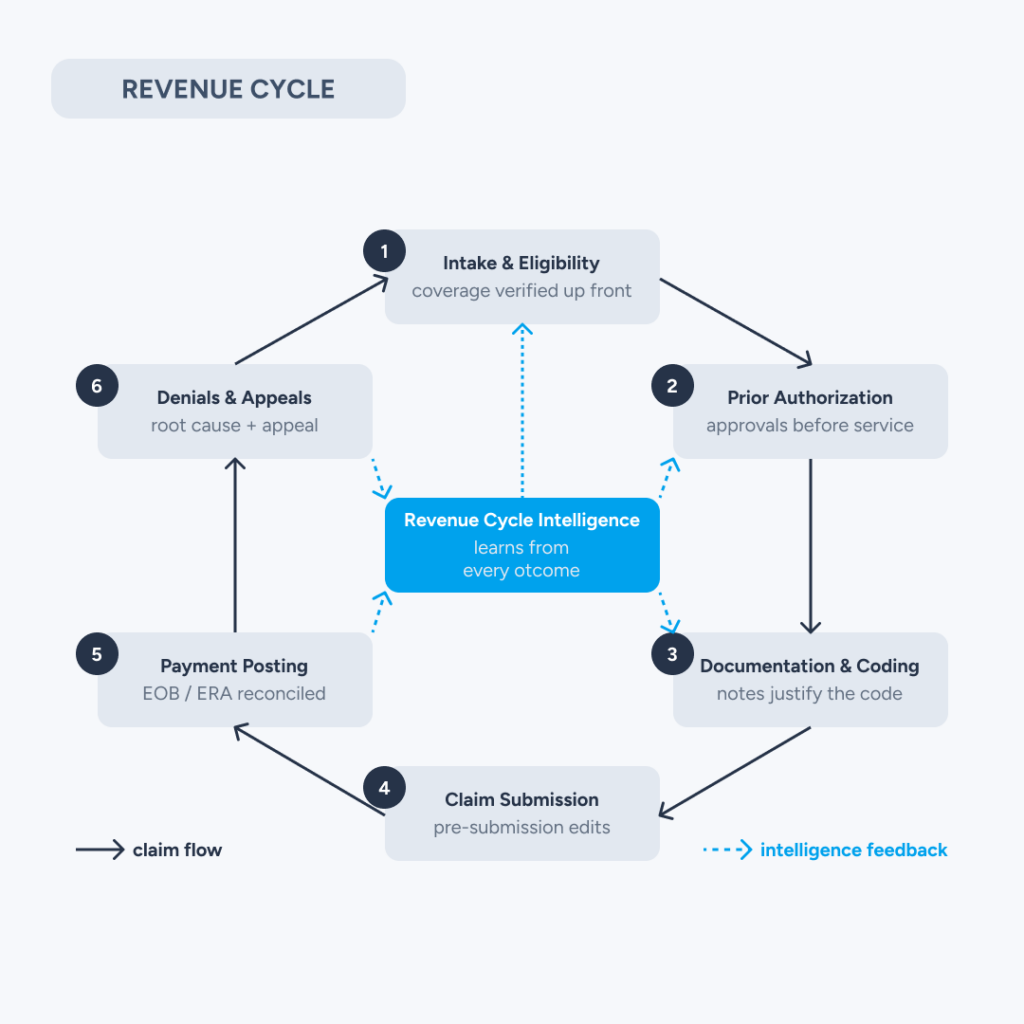
That distinction matters. Basic analytics tells you what already happened. Revenue cycle intelligence helps you detect revenue leakage while there is still time to correct it in the chart, the queue, or the claim. In practice, that is how clinics improve revenue cycle performance: by tying operational activity to reimbursement outcomes and prioritizing the fixes that affect cash fastest.
This article breaks leakage into the points that matter most in daily operations: intake, coding, prior authorization, claim submission, appeals, and payment posting. Each section will cover one best practice, with a specific operational problem and a practical way to reduce denials, undercoding, missed charges, and bottlenecks.
That is the buyer value in plain language: fewer avoidable denials, cleaner documentation, faster reimbursement, and less manual rework across the revenue cycle. Platforms built for this layer, including cliexa’s billing insights, focus on denial patterns, payer-specific documentation pitfalls, and claim-level root causes rather than generic reporting.
2. The 7 best practices and the revenue-cycle problem each one solves
Use this as the quick scan before the deep dive: each best practice maps to a different leakage point, so clinic teams can start with the highest-friction problem and enterprise teams can see where revenue cycle intelligence belongs in the workflow.
|
# |
Best practice |
Revenue-cycle problem it solves |
Best-fit use case |
Standout operational benefit |
|---|---|---|---|---|
|
1 |
Denial-driven intelligence |
Repeated denials and rejections |
High-denial specialties, payer-heavy clinics |
Finds payer patterns early and reduces repeat work |
|
2 |
EOB/ERA analysis |
Slow root-cause review |
Teams reconciling remits at scale |
Turns payment data into actionable denial clusters |
|
3 |
Documentation-to-code alignment |
Under-coding and medical-necessity gaps |
Clinics with variable note quality |
Connects clinical documentation to billing logic |
|
4 |
Prior auth and eligibility checks |
Preventable front-end denials |
Access teams and scheduling workflows |
Catches coverage issues before the claim is built |
|
5 |
Claim prioritization by likelihood |
Workqueue overload |
Billing teams with limited follow-up capacity |
Focuses staff on claims most likely to pay |
|
6 |
Appeal language support |
Low appeal success rates |
Denial management teams |
Standardizes appeal responses and supporting evidence |
|
7 |
Closed-loop learning |
Leakage that keeps repeating |
Enterprise RCM and multi-site operations |
Feeds outcomes back into policy and workflow |
This framework reflects the core shift in revenue cycle intelligence: it connects documentation, payer rules, and claim outcomes into one operating loop.
3. Use denial analytics to catch payer patterns before claims go out
This best practice is for revenue cycle teams that are tired of fixing the same denial twice. The goal is to stop avoidable rejections before the claim leaves the system, rather than working a queue faster after the fact. That is where revenue cycle intelligence becomes operational, not theoretical.
Denial analytics should cluster root causes by payer, code set, service line, and documentation issue. For example, one payer may repeatedly reject a CPT code when a specific modifier is missing, while another may deny the same service because the note does not support medical necessity. A useful platform separates those patterns instead of lumping all denials into one generic dashboard. That gives billing, coding, and clinical documentation teams a clear fix path.
The stronger models do more than count denials. They learn from EOB/ERA data, appeal outcomes, and payer-specific response patterns so the next claim is cleaner than the last one. cliexa’s billing insights approach describes this loop directly: AI learns from denials and rejections, identifies payer-specific patterns and documentation pitfalls, parses EOB/ERA, clusters root causes, and supports appeal language. That same logic should be pushed upstream into pre-submission review.
Pre-submission review matters because post-denial work queues are expensive. Once a claim is rejected, staff spend time researching the issue, correcting the record, and resubmitting under payer deadlines. A better workflow uses analytics to trigger edits before submission, route high-risk claims to the right queue, and prompt clinicians for missing documentation while the encounter is still fresh. That is how AI platforms optimize healthcare revenue cycle operations: by turning denial history into claim-level guidance.
The most mature systems also rank claims by likelihood of payment and speed to cash. That helps teams prioritize clean claims, isolate risky ones, and focus follow-up where it will move reimbursement fastest. In practice, that means fewer repeat denials, less undercoding, fewer missed charges, and a tighter feedback loop between documentation and reimbursement.
4. Align documentation and coding to reduce undercoding and medical necessity misses
This best practice is for revenue cycle and operations teams that need to stop revenue leakage before a claim is submitted. In plain language, undercoding means the chart supports a higher-complexity service than the code that was billed. That usually starts upstream: the note is incomplete, the medical decision-making is not clearly documented, or the record does not show why the service was medically necessary.
A revenue cycle intelligence layer helps by checking the chart against the rules that govern payment. Instead of treating coding as a back-office cleanup task, it can cross-reference ICD diagnosis codes, CPT procedure codes, lab results, and prior authorization requirements to see whether the documentation supports the claim. That matters because many denials are not simple coding mistakes; they are documentation-to-code misalignment problems. The code may be technically valid, but the note does not prove the service was warranted under payer policy.
This is where analytics becomes operational. By reviewing denials, rejections, and write-offs across providers, specialties, and service lines, teams can spot recurring medical necessity gaps. For example, one specialty may repeatedly miss required symptom detail, while another may under-document time, severity, or failed conservative treatment. Those patterns are more useful than one-off denial counts because they show where the workflow is breaking.
The goal is better documentation prompts at the point of care, so clinicians capture the facts coders and payers need the first time. That reduces avoidable denials, lowers rework, and closes the gap between clinical reasoning and reimbursement. cliexa’s billing insights approach is built around that feedback loop: learn from denials, identify documentation pitfalls, and feed the result back into workflow so missed charges and undercoding are caught earlier.
5. Detect missed charges and charge capture gaps in high-volume workflows
This best practice is for revenue cycle and operations teams that need to find services that were performed but never fully captured, posted, or billed. In plain terms, a missed charge is revenue left on the table because the clinical event happened, but the billing workflow did not convert it into a claimable charge. In high-volume settings, that gap can be small on any single encounter and still material at month end.
Charge leakage usually shows up in specialty, ancillary, and fast-moving workflows: injections, supplies, procedures with add-on codes, lab work, imaging, infusions, and visits where documentation is split across systems. The risk is highest when staff rely on manual charge entry, when orders and results live in different systems, or when coding depends on memory instead of structured evidence. That is where revenue cycle intelligence becomes useful: it compares clinical activity, orders, documentation, and billing events to identify what should have been billed but was not.
The practical model is a three-way match. First, the platform looks at what was ordered or documented. Second, it checks what was posted to the account. Third, it flags mismatches by service line, provider, location, and payer. This is more specific than generic revenue leakage reporting because it separates missed charges from denials and undercoding, then ranks the gaps by likely dollar impact and recovery probability.
That prioritization matters. A clinic does not need a long list of every missing charge; it needs the highest-value gaps first, especially where the same pattern repeats across many encounters. Platforms that learn from claim outcomes can surface recurring misses, such as unbilled supplies or add-on services tied to a procedure.
The result is cleaner reconciliation, fewer manual audits, and fewer end-of-month surprises. Instead of discovering leakage after close, teams can correct the workflow while the encounter is still fresh and the documentation is still actionable.
6. Use workflow bottleneck analytics to prioritize queues and speed cash
This best practice is for revenue cycle and operations teams that need to move beyond “more visibility” and into actual queue control. The goal is simple: find where work stalls, rank the work by financial impact, and route staff to the claims and exceptions most likely to recover cash first. That is the practical role of revenue cycle intelligence.
Start by mapping the full path: intake, prior authorization, coding, claim submission, appeals, and payment posting. Each step can create a different kind of delay. Intake errors create downstream rework. Prior auth gaps hold up scheduling or claims. Coding mismatches trigger denials. Submission defects create rejections. Appeals can sit untouched. Payment posting can hide underpayments if adjustments are not reconciled quickly.
The useful dashboard is more than a volume report. It should show where leakage occurs, where work is backing up, and which queues are aging fastest. It should also tie those bottlenecks to payer behavior and claim value. A low-dollar task that is easy to clear does not carry the same weight as a high-value claim with a strong recovery probability. AI can help rank work by expected reimbursement, denial risk, payer turnaround patterns, and the likelihood that a fix will actually convert into payment.
That is how AI-powered platforms optimize healthcare revenue cycle operations: they prioritize the right work over the sheer volume of work. In practice, that means surfacing claims with the highest chance of recovery, routing exceptions to the right team, and flagging repeat failure points before they spread across the queue.
This approach reduces administrative burden because staff spend less time sorting and more time resolving. It also shortens reimbursement cycles by clearing bottlenecks earlier, especially when the platform learns from historical denials, appeals, and payment outcomes. For teams managing thin margins, the benefit is operational and financial: faster throughput, fewer stalled claims, and a cleaner path from documentation to cash.
7. Close the loop with payer feedback, appeals, and continuous learning
This best practice is for revenue cycle and operations teams that want fewer repeat denials, faster follow-up, and clearer accountability. The core idea is simple: claim outcome data should not sit in a report. It should change the next decision. In a closed-loop model, denial codes, payer responses, appeal results, and posting data feed back into documentation review, coding edits, and workqueue routing so the next claim is cleaner than the last.
That is where revenue cycle intelligence becomes operational, not theoretical. EOB/ERA parsing can surface patterns in what payers actually paid, reduced, or rejected, while appeal outcomes show which documentation elements were persuasive and which were not. Over time, that creates a more accurate root-cause view. Instead of a flat “denials are up,” the picture gets specific: “this payer is rejecting this CPT/diagnosis combination when prior auth language is missing,” or “these claims need stronger medical necessity support before submission.” cliexa’s billing insights page describes this loop directly: automated EOB/ERA parsing, root-cause clustering, appeal language support, and real-time feedback into coding and documentation.
Payer-specific learning matters because denial behavior is rarely uniform. One plan may tighten policy after a coverage update; another may reject the same service for a documentation gap that only appears in a specific specialty or location. If your analytics do not separate payer behavior from general claim volume, you will keep fixing the wrong problem. The better model tracks repeat denials by payer, service line, and reason code, then pushes those findings into governance: updated templates, coding rules, prior-auth checks, and escalation paths.
That governance layer is what turns analytics into operational accountability. Teams can assign owners, measure remediation, and verify whether a fix actually reduced leakage. In practice, that means the platform improves revenue cycle performance rather than simply reporting it.
For platform specifics on how this works in practice, review the cliexa billing insights overview.
The bottom line
Revenue leakage is rarely one big hole. It’s denials, undercoding, missed charges, and stalled queues adding up across every stage of the cycle. Revenue cycle intelligence closes those gaps by connecting documentation, payer rules, and claim outcomes into one operating loop, so every denial and remit teaches the next claim. Start with your highest-friction leak, tie the fix to a dollar impact, and let the outcomes feed back into documentation and coding. The payoff shows up as fewer avoidable denials, cleaner charts, and faster cash, without adding another dashboard for your team to babysit.
Find your revenue leaks with cliexa
Denial analytics only helps if your team trusts it and acts on it. In a 30-minute walkthrough, we’ll show how cliexa clusters denials by payer, explains what drove each one, and routes the right next step right inside your workflow — no black box, no extra dashboard to check.
Frequently Asked Questions
What is revenue cycle intelligence?
It is the use of analytics to connect clinical documentation, coding, payer rules, and claim outcomes in one view. In plain terms, it helps teams see why revenue is lost, where it is delayed, and what to fix first. Unlike generic reporting, revenue cycle intelligence is built to support action rather than mere observation.
How do clinics identify revenue leakage with analytics platforms?
They look for patterns across denials, rejections, undercoding, missed charges, and slow payment cycles. A useful platform does more than count problems. It clusters root causes, shows which payers or service lines are involved, and ranks issues by financial impact so teams can work the highest-value fixes first. That is the practical difference between dashboards and revenue cycle intelligence.
How does AI improve operations without replacing existing systems?
AI should sit on top of the EMR, scribe, and billing stack, not replace them. Its job is to govern the clinical reasoning layer: check whether documentation supports the code, flag missing details before claims go out, and feed denial patterns back into workflow. This keeps the current system intact while improving decision quality and throughput.
What is the difference between denial analytics, undercoding detection, missed-charge detection, and workflow optimization?
They solve different problems. Denial analytics explains why claims were rejected or denied. Undercoding detection finds cases where the documented service supports a higher, correct code. Missed-charge detection looks for billable work that never made it onto the claim. Workflow optimization focuses on bottlenecks, such as prior auth delays, incomplete documentation, or queue backlogs.
What should clinics evaluate before buying a platform?
Look for payer-specific learning, EOB/ERA parsing, appeal support, and clear links between documentation and claim outcomes. The best systems help teams close the loop: detect leakage, fix the cause, and measure whether the correction worked.