
Step 1: Define the operational problem before you buy a model
Start with the problem you need to solve: identify patients at higher risk for opioid use disorder before harm escalates. In practice, that means finding the right people early enough to change the next decision, not waiting for a crisis, overdose, or repeated ED visit.
Treat an OUD risk score as a scoring and triage tool, not a diagnosis. A score should help a care team rank who needs outreach, closer follow-up, or a same-day review. It should not replace clinical judgment or a structured assessment. That distinction matters because digital tools can miss context, and they can also flag patients who need a human review rather than an automatic intervention. Reviews of digital screening and prediction tools have repeatedly pointed to missing data, false positives, and alert fatigue as implementation risks (JAMA Network Open, Nature npj Digital Medicine).
Place the score where clinicians already work: inside the EHR at prescribing, refill, ED discharge, or care management review. That keeps the workflow simple and the action clear.
This guide focuses on enterprise implementation, not model theory alone. Next, you will map the prerequisites, build the workflow, choose the intervention for each risk tier, troubleshoot alert volume, and track outcomes so leaders can see whether the program changes care.
Step 2: Prerequisites for opioid risk scoring
Start by assembling the data feeds before you score anyone. A usable opioid risk model needs claims, medication history, diagnoses, prior overdoses, emergency department visits, PDMP data, labs, and social risk inputs such as housing instability or transportation barriers. Reviews of digital opioid risk tools consistently warn that models fail when key inputs are missing or inconsistent, especially across care settings (risk assessment in the digital age).
Map the EHR fields next. At minimum, connect problem lists, encounter history, medication orders, discharge data, and past substance use documentation to a single patient record. If your team cannot reliably link those fields to the same person, the score will drift from site to site and lose trust at the bedside.
Set the interoperability rules before launch. Define how claims, PDMP, and lab feeds enter the EHR, how often they refresh, and which identifiers match records across facilities. Clean feeds matter because a score built on stale medication lists or partial encounter history will miss recent overdose events and overstate or understate risk.
Assign governance in writing. Decide who can view the score, who owns model monitoring, and who approves workflow changes. That usually includes clinical operations, addiction medicine, informatics, compliance, and data governance. Without named owners, alert thresholds and escalation paths change informally, and no one can explain why.
Budget time for validation. Most teams need several weeks and a small working group of clinicians, analysts, and IT staff to test input completeness, compare outputs against known cases, and fix mapping errors before go-live. That upfront work is what makes the technology reliable enough to use in daily care.
Step 3: How to screen and stratify patients with digital risk tools
Start with clear trigger points. Screen when a clinician writes an opioid prescription, a patient requests a refill, the ED discharges a patient with pain, or a care team completes post-discharge follow-up. Those are the moments when data already exists in the chart and staff can act fast.
Capture the inputs the model needs. At minimum, pull recent opioid fills, dose, prior overdose or substance use history, ED use, recent hospitalization, and gaps in follow-up. If your data feed is thin, say so in the workflow. Missing medication history can distort the score.
Use the score to sort patients into risk tiers. Risk stratification means grouping patients into higher- and lower-risk buckets based on the inputs, so staff know who needs outreach first. A four-tier setup works well: minimal risk continues routine care, low risk gets standard monitoring, medium risk gets a nurse call or pharmacist review, and high risk gets same-day outreach, naloxone review, and a prescriber alert.
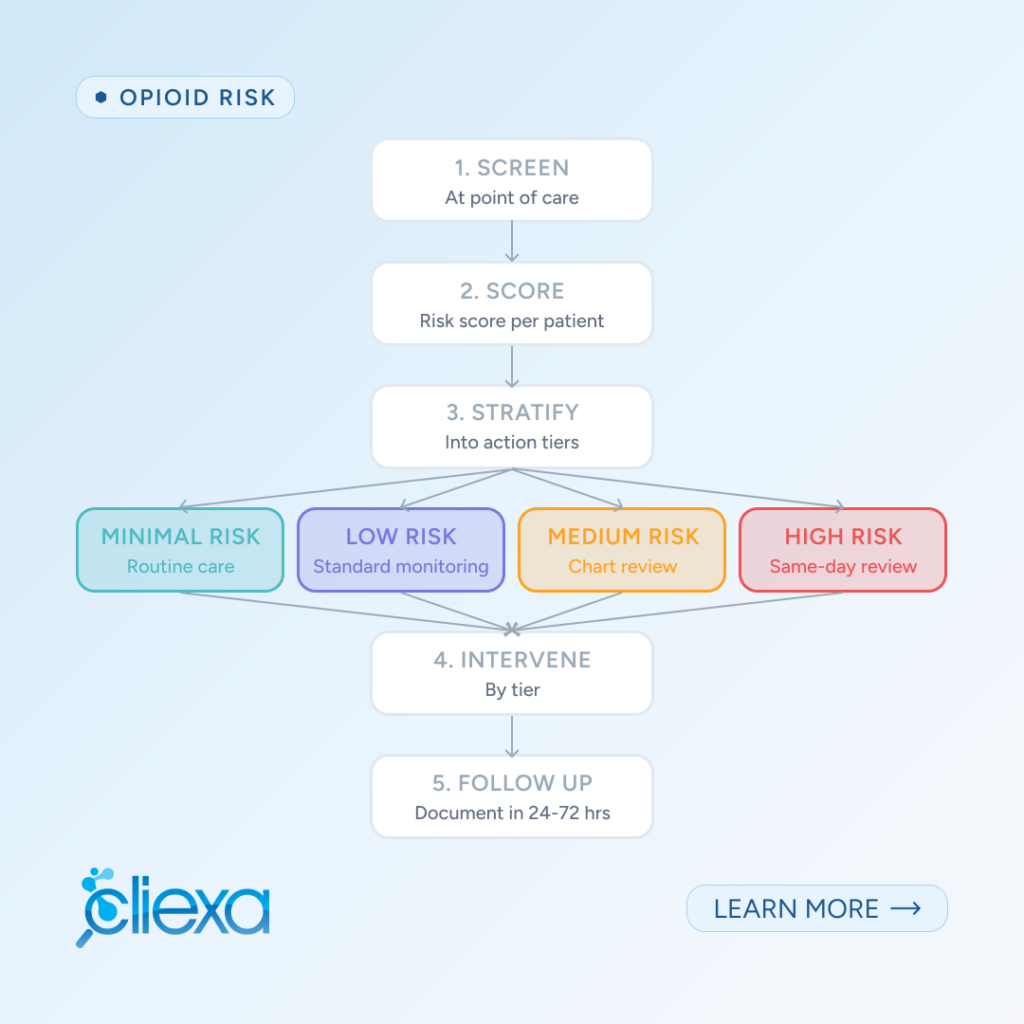
Step 4: Ordered workflow for screening, risk stratification, intervention, and follow-up
- Screen every eligible patient at the point of care. Use structured data already in the chart: prior opioid prescriptions, overdose history, ED visits, substance use diagnoses, mental health comorbidities, and recent care gaps. The goal is simple: identify patients who need a closer look, not replace clinical judgment. Reviews of digital screening tools note that missing data and inconsistent documentation can distort results, so standard inputs matter (risk assessment in the digital age).
- Score the patient. Run the model automatically in the EHR or care management platform and generate a clear risk score or tier. Keep the score visible to the clinician, care manager, and pharmacist so each role sees the same signal.
- Stratify into action tiers. Minimal-risk patients continue routine care. Low-risk patients may need standard monitoring. Medium-risk patients should trigger a chart review. High-risk patients should move to same-day review by a clinician or care manager. This step reduces alert overload and helps teams focus on the patients most likely to benefit from intervention.
- Intervene based on the tier. For high-risk patients, use a defined playbook: patient outreach, medication review, naloxone education, referral to MOUD or MAT, and closer monitoring. MOUD means medications for opioid use disorder; MAT is the older term, medication-assisted treatment. A pharmacist can review concurrent sedatives, early refills, and dose escalation. A care manager can close referral loops and schedule follow-up.
- Follow up fast and document the outcome. Set a target follow-up window of 24 to 72 hours after a high-risk alert, then again after any referral. Document contact attempts, patient response, medication changes, referrals placed, naloxone counseling, and next review date. If the patient does not engage, record the barrier and the next outreach plan.
This workflow helps teams miss fewer high-risk patients and shorten the time from alert to action: faster review, more consistent intervention, and better tracking of what happened after the alert.
Step 5: How digital risk tools improve patient outcomes
Use opioid risk scoring to find high-risk patients earlier and route them to action faster. This means flagging patients before a missed refill, an ED return, or a high-risk prescription turns into a crisis. The outcome leaders care about is simple: fewer patients fall through the cracks, and care teams spend less time hunting through charts.
Integrate the model into the EHR workflow, not a separate dashboard. According to the CDC’s clinical guidance, EHR-based tools are essential for supporting safer opioid prescribing and follow-up, while ONC’s Opioid Use Disorder Playbook frames health IT as a way to connect screening, treatment, and longitudinal care. When the alert appears where clinicians already work, teams can triage patients into the right next step: same-day outreach, behavioral health referral, naloxone education, or MOUD/MAT follow-up.
Measure the result in operational terms: fewer manual chart reviews, faster outreach to patients who need MOUD, cleaner reporting for quality teams, and better coordination across primary care, behavioral health, and pharmacy. This is where digital risk prediction earns its keep.
Step 6: Troubleshooting false positives, missing data, and alert fatigue
Treat every high-risk flag as a prompt for clinical review, not a verdict. A flag warrants a chart review, a PDMP check, and a quick clinician check-in so the team can confirm whether the pattern is clinically meaningful before acting. False positives are common: a recent surgery, a short post-operative prescription, or a patient with frequent visits but no misuse can all look risky to a model. Asking clinicians to assess the context first keeps the score in its proper role: a starting point for judgment, never a diagnosis.
Check data completeness before you trust the score. Missing claims, incomplete PDMP pulls, absent lab results, or thin social risk data can push a patient into the wrong risk band. If the model cannot see recent fills, toxicology, or housing instability, it may understate or overstate risk. Build a rule that labels scores as “partial data” when key inputs are missing, so clinicians know when to interpret the result cautiously.
Limit who sees the alert and when it fires. Alert fatigue starts when every low-value signal reaches every user. Route high-risk alerts to the right role: the prescriber, care manager, or addiction medicine team, and suppress repeat alerts for the same patient within a defined window. Keep the alert tied to an action, such as PDMP review, naloxone offer, or referral, so it supports the workflow instead of interrupting it.
Audit the program on a fixed cadence. Review score performance, override rates, and downstream actions each month or quarter. If clinicians ignore the alert or the same patients keep triggering without follow-up, the workflow needs tuning. Include drift checks and frontline feedback in model monitoring so the tool stays aligned with current patients, current prescribing patterns, and real clinical use.
The bottom line
- Get the data right: medication history, prior overdose, diagnoses, utilization, and social risk fields.
- Fit the score into the EHR: place it where clinicians already work.
- Act on the result: define who gets outreach, same-day review, or care coordination across the four risk tiers.
- Monitor performance: watch false positives, missed cases, and alert fatigue.
For background on the limits of screening and the need for meaningful workflows, see the discussion in risk assessment in the digital age.
See how cliexaAI scores opioid risk
An opioid risk score only helps if your team trusts it and acts on it. In a 30-minute walkthrough, we’ll show how cliexaAI stratifies patients into clear risk tiers, explains what drove each score, and routes the right next step right inside your EHR — no black box, no extra dashboard to check.
Frequently Asked Questions
How do digital opioid risk tools help improve patient outcomes?
They help teams find higher-risk patients earlier, so staff can prioritize outreach, follow-up, and treatment referral. In practice, that can mean faster review after an ED visit, more consistent monitoring, and fewer patients falling through gaps in care.
Do these tools replace clinician judgment?
No. They should support clinical judgment with a consistent risk signal. A score is a prompt for action, not a final decision.
What is the biggest implementation mistake?
Using a score without a workflow. If no one owns the next step, the tool adds noise instead of improving care.